Guides
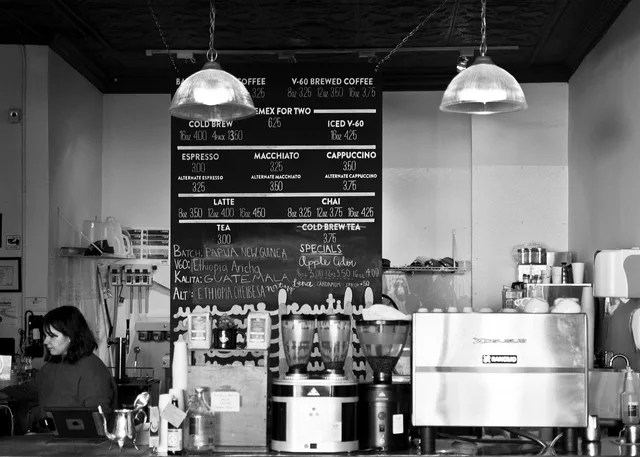
Coffee shop menu changes: check bar capacity, test one item
Coffee shop menu changes without guesswork: read the size and add-on steps, check bar capacity first, test one item for two weeks and keep the records.
Before a coffee shop changes anything on its menu board, two checks decide whether the change can work: whether the bar is already at capacity in the morning, and whether the change is tested on one item at a time. This guide covers both, along with the relationships between items that customers actually read.
What to take away
- Price the menu as a structure. Customers read the relationships between prices more than any single number.
- Your revenue ceiling in the morning is set by bar throughput, not by price. Raising a price does not add a cup you had no time to make.
- Change one price at a time and write down beforehand what result would justify keeping it.
- Cost increases arrive from a global commodity market. Decide your response rule before you need it.
- The numbers that decide your board come from your own costs, your area and your format. This guide is the method for reading and testing them.
The structure customers actually read
Nobody compares your price to a benchmark. They compare it to the price beside it, to what they paid last week, and to the alternative they had this morning.
Three relationships do most of the work:
The structure customers read
- The step between sizes. Too small and everyone buys large, which changes your milk usage overnight. Too large and the small looks like the only sensible choice.
- The price of an add-on against the drink. A charge that reads as a penalty for a dietary need is remembered, and it is remembered out loud.
- The gap between the simplest drink and the most complex one. That gap is where a customer decides whether your shop is expensive.
Set those three deliberately before you set any individual number, and check them again every time you move one.
Price does not raise the ceiling
During the morning block the limit is how fast finished drinks leave the bar. If you are selling everything the bar can produce, a price rise increases revenue per cup and nothing else. If you are not, the constraint is demand, and the answer is elsewhere.
Are you at the bar ceiling?
Count sales in five minute buckets across peak
Compare against what the bar can produce
Yes -> capacity, workflow, move demand out of block
So establish which one you are before touching prices. The check takes three mornings and a sheet of paper:
- Count what the bar finishes.On a morning with a standing queue, have someone tally every drink handed over, in five minute buckets, from open until the queue first clears. The highest count you see in a bucket while people are still waiting is what your bar can produce in five minutes with that crew and that equipment.
- Count what you sell.From the till, take sales in the same five minute buckets across the peak, on the same mornings.
- Time the slow drinks.With a stopwatch, time order-to-handover for each drink type that sells in the peak, several times each. The slowest common drinks are the ones that pull the five minute count down.
- Compare.If sales sit at the bar's count for bucket after bucket while the queue stays, you are at the ceiling. If sales fall short of that count while the bar has slack, the limit is demand.
Do it on three separate weekdays, because one morning can mislead you in either direction.
A shop at its ceiling has a different problem list: capacity, workflow, and moving demand out of the block. A shop below it has a pricing and marketing problem. Treating one as the other wastes a year.
The quiet hours are carried by the busy ones
Rent runs through the afternoon at the same rate. That means the price of a morning coffee is partly paying for the hours when almost nothing sells.
Two ways to handle it, and they are different decisions. Carry the quiet hours in the price of the peak, and accept that. Or change what the quiet hours are for, with a different product, a different visitor, or shorter opening. What does not work is pretending the afternoon pays for itself.
Costs move for reasons outside the shop
Green coffee is traded globally. Production, exports and stocks are reported publicly, and the USDA Foreign Agricultural Service publishes Coffee: World Markets and Trade covering those movements across origins and seasons.
Write your response rule now, while nothing is happening. It has three parts: what size of cost move triggers a review, what you will do first, and who decides. Shops without such a rule absorb every increase until the year is over and the margin has gone quietly.
The inputs to that rule come from your own counts: usage against recipe, waste by item, and the delivery pattern your storage can absorb, all taken from your stock records.
Changing a price without guessing
- Pick one item. One.
- Write down what you expect to happen to its unit sales and to the items around it.
- Change it, and change nothing else on the board.
- Run it for two full weeks so a slow week and a busy one are both included.
- Compare unit sales, and separately compare how long the peak queue takes to clear.
- Keep, revert, or adjust, and write down the reason.
Step five catches the case people miss. A price change that shifts customers onto a slower drink can raise revenue per cup and reduce the number of cups you can make, which is a loss dressed as a gain.
Six steps to change one price
- Pick one item only
- Write expected unit sales effect
- Change it, nothing else
- Run two full weeks
- Compare units and peak queue
- Keep, revert, or adjust
What the board says is a claim
Words like organic, single origin, fresh or locally roasted are advertising claims, not decoration. The Federal Trade Commission's advertising guidance for small businesses sets out the principle that claims must be truthful and substantiated, and keeping the paperwork behind each word is the cheap part of that.
The same applies to a discount described as a saving. Whatever comparison the sign implies should be one you could show.
Tips are a separate question, with separate authorities
Tipping affects what staff earn and how a customer reads your prices, but the rules around it are not yours to invent. How tips may be pooled, shared, or treated against wages is governed by federal and state law, and the position differs by state and changes. At federal level the law is the Fair Labor Standards Act: section 3(m) sets the tip credit an employer may take, and section 3(t) defines who counts as a tipped employee for that purpose.
The Internal Revenue Service page on tip recordkeeping and reporting covers the recordkeeping and reporting side.
For what you may actually do with tips, ask the US Department of Labor and your state labor agency directly. Take advice from a qualified professional before setting up any arrangement, and remember that copying another shop can lead to an unaffordable dispute.
The records that make pricing arguable
Keep purchase records, counts, recipes and sales by item. The Internal Revenue Service page on what kind of records to keep sets out the expectation that a business supports its figures with documents.
For pricing specifically, the records answer the question a price change always raises: did the cost actually move, or did the pour? Without counts, those two look identical.
Menu design and permissions feed the price list. Each item's load on the bar is the stopwatch time you took in the capacity check, so keep those timings with the recipe cards.
Renewals, fees and training from the permissions the shop holds are recurring costs. Put them in the price, not in a surprise.
Occupancy cost per open hour, the other large fixed input, is your rent and other fixed premises costs for a period divided by the hours you were open in it.
Common questions
Should I round prices to whole units?
It speeds cash handling and makes the board easier to read. Test it like any other change, on one item first, and watch what it does to the size step.
Is it better to raise prices or shrink the drink?
Raising the price is honest and visible. Changing the drink without saying so is noticed, usually by your best customers, and it costs more than the increase would have.
How often should prices be reviewed?
On a schedule and on a trigger. A schedule stops the review being forgotten, and a trigger, tied to a defined move in your input costs, stops you waiting for the schedule.
Do loyalty discounts belong in pricing?
They are pricing, and they should be costed as such. A free drink given after several purchases is a discount on all of them, so work out the effect on contribution before deciding the threshold.