Guides
How to price coffee shop services: scope, cost lines, quote
How to price coffee shop services such as catering, wholesale or an event bar: write the scope, cost four lines, quote above the floor, then check the margin.
What to take away
- A catering job, wholesale account or event bar is priced from a scope, not from the menu.
- Write the scope firstsetup, duration, travel and service rate.
- Cost four lineslabor hours, ingredients and packaging, transport and equipment, and a share of overheads.
- The quote sits above the total of those lines, and the scope goes into the confirmation so an extra hour is billable.
- After the job, work out the margin and find which line moved if it is thin.
Why a job is not a big drink order
Drinks are priced from a structure. A catering job, wholesale account or event bar is priced from a scope. Never confuse the two, because a number that works at the counter says nothing about a day spent somewhere else.
Selling outside the counter is a different business attached to yours. See how a coffee shop grows into new channels and sites. How the menu board itself is priced is covered in menu changes and bar capacity.
Write the scope before any number
A scope has four parts: setup, duration, travel and service rate. Write each down before giving a number, because every part turns into a cost line and an unwritten part becomes unpaid work.
| Scope part | What to write down | Cost line it feeds |
|---|---|---|
| Setup | What is carried, built and tested before the first serve, and the time that takes | Labor hours |
| Duration | When service starts and finishes, and how many serves are expected | Labor hours and ingredients |
| Travel | Distance, loading, and any equipment hired or taken off your own bar | Transport and equipment |
| Service rate | What is served, and how fast it has to leave the bar | Ingredients, packaging and bar time |
Costing the serves
Ingredient cost comes from weighing, not from the recipe card. Weigh the dose, the milk actually poured and the syrup actually pumped on a working bar, not a quiet one. Then add the packaging and the share of any batch discarded rather than sold.
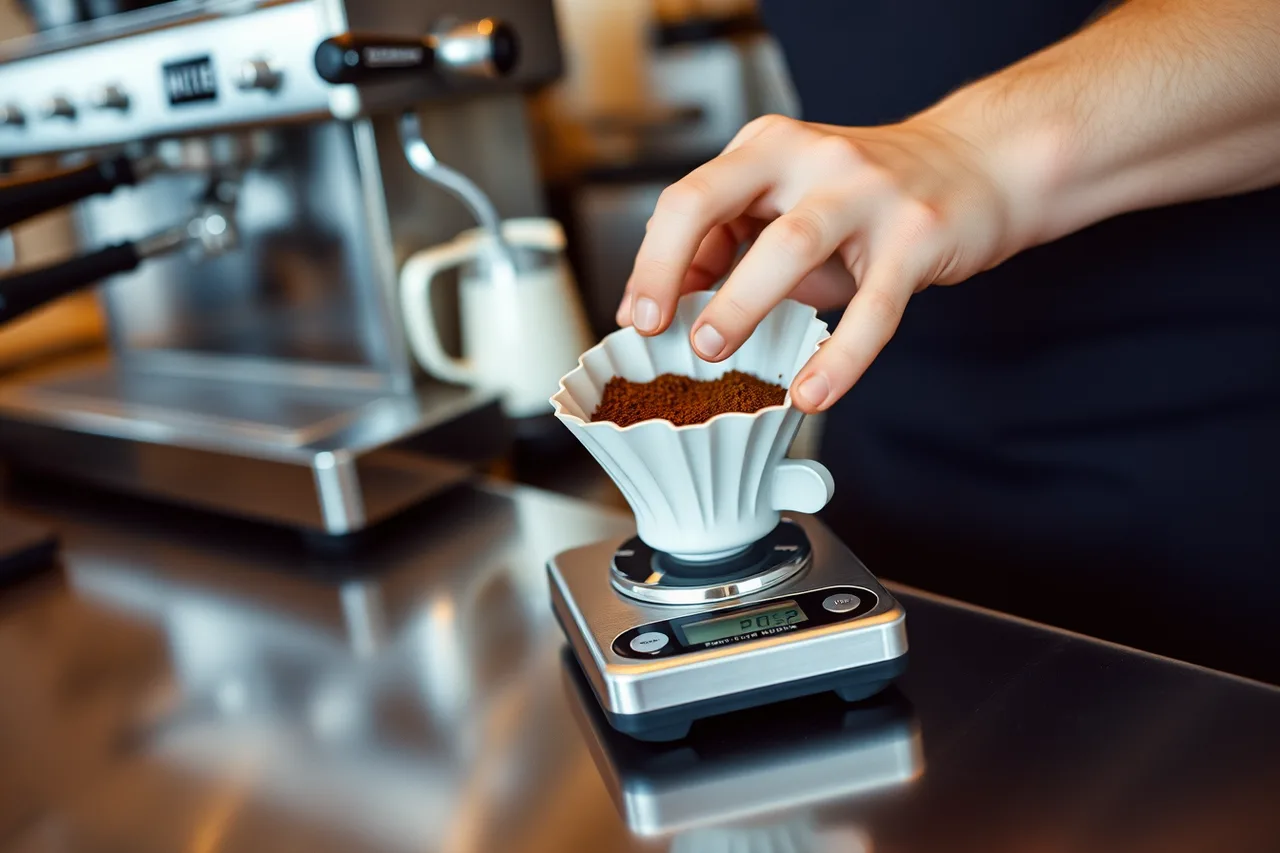
Multiply each weight by what you paid per unit of weight on the latest invoice. The waste share is the cost of that item discarded in a month divided by the units sold in that month.
Measured pours run over recipe more often than under, and on a milk heavy menu that is where most of the unexplained cost sits. The counting discipline behind this is in how a shop counts stock and logs waste.
Costing the hours
Labor hours cover setup, service, breakdown and travel, each multiplied by the loaded hourly cost of the person you send. Loaded means the wage plus the employer's payroll taxes and benefits.
Bar time sets how many serves one person can pour in an hour. Time the same item with a stopwatch, from ticket to handoff, on a busy shift, and use the time that holds when three tickets are already waiting.

A milk drink that takes 90 seconds from ticket to handoff uses one fortieth of an hour of bar time. A filter coffee poured from a batch in 15 seconds uses one two-hundred-and-fortieth, six times less. The timing is an illustration, but the serve mix matters as much as the serve count.
The wage itself has to meet the legal minimum, with tip-credit rules for tipped staff as the main exception. The Fair Labor Standards Act (29 U.S.C. 206) generally requires covered employers to pay at least the federal minimum wage of $7.25 per hour, the rate in effect since July 2009.
Where an employee is covered by both state and federal minimum wage laws, they are entitled to the higher of the two. Payroll taxes and benefits then raise the loaded figure further.
Choosing the serve mix
The serve mix changes the labor line more than the serve count does. If a milk drink and a filter coffee sit at the same price, the milk drink carries six times the labor inside it, so the floor is worked out per item.
An item can be cheap in ingredients and expensive in bar time, the one resource you cannot buy more of before nine o'clock. For a job, that points to a short list of serves that leave the bar quickly, with slower drinks priced for what they consume or left off.
Costing the overhead share
A job ties up your staff and equipment, so it carries a share of overheads. Divide the month's carried costs by the units you expect to sell that month, and the job takes that share for the time it holds the bar.
Those costs include occupancy through the quiet hours and the permissions and renewals in the register the shop maintains. They also include the training of people who will not be here next year, and the equipment service you have to schedule anyway. Training is a running cost rather than an opening one, as recruiting and training bar staff makes clear.
Below that floor you are selling at a loss you cannot see until the year ends.
Building the quote
The quote sits above the total of four lines. Add them for the job, then add your margin on top, so the price is a floor plus a decision rather than a guess.
- Labor hours for setup, service, breakdown and travel, multiplied by the loaded hourly cost of each person you send.
- Ingredients and packaging for the expected number of serves, costed from your weighing results.
- Transport, and any equipment you hire or take off your own bar for the day.
- A share of overheads for the time the job ties up your staff and equipment.
Put the scope you wrote down into the confirmation, so that an extra hour is billable rather than absorbed.
As a formula, the floor is hours times loaded hourly cost, plus ingredients and packaging, plus transport and equipment, plus the overhead share. The quote is that floor plus your margin. No standard margin is given here, because it depends on your own costs and the job.
The serve mix moves the first term. With a loaded hourly cost of L, the milk drink above carries L divided by 40 of bar time and the filter coffee carries L divided by 240. A job heavy on milk drinks has a higher floor than the same number of filter serves, and the quote has to show it.
For work away from your own premises, also ask the local health department whether the job needs a permit of its own, and add any cost it brings to the transport and equipment line.
The most common error is quoting an event at menu prices. The menu price assumes your bar, your equipment and no transport.
Checking the margin after the job
Margin is the gap between the quote and the cost floor, divided by the quote. Work it out after the job from the hours actually worked and the stock actually used, and compare both with the scope you wrote.
The figure from your last job is the benchmark for the next one. When the margin is thin, find out which line moved before you touch the next price. Three things could have happened, and they have different fixes.
| What changed | How to confirm | The fix |
|---|---|---|
| Supplier price | Compare invoices against the quoted price and the notice you were given | Reprice, or renegotiate notice terms |
| Pour or portion | Weigh again, on a busy shift, with a different person | Briefing and a recipe card, not a price change |
| Waste | Read the waste log by item and reason | Order size or handling, depending on the reason |
Repricing to cover a pour problem raises the price and leaves the problem in place.
Staff, tips and records on a job
Event staff are labor like any other. Tips interact with labor cost and with how customers read your price. Rules differ by state and change. For what you may do with tips at an event bar, ask the US Department of Labor and your state labor agency.
The Internal Revenue Service page on tip recordkeeping and reporting covers recordkeeping and reporting. It points to Publication 531, Reporting Tip Income, and to Publication 3144, Tips on Tips (A Guide to Tip Income Reporting) for Employers. It also points to Form 8027, Employer's Annual Information Return of Tip Income and Allocated Tips. Take professional advice before setting anything up.
Keep invoices, recipes, weighing results and sales exports for each job. Without those, a price argument is a memory contest.
Common questions
Should I match another shop's catering price?
Only by coincidence. Their price carries their rent, their volume and their equipment. Set the numbers from your own measurements.
What if the client wants a lower price?
Cut the scope, not the margin. Fewer serves, a shorter service or a simpler serve mix change the lines, and the confirmation records what was removed.
How do I price a serve that takes twice as long to make?
Price it for what it consumes, including bar time, and then decide whether to include it in a job at all. Some items belong on the afternoon board only.