Guides
Retail Coffee Shelf Plan: Everyday, Better, Occasion
A cafe shelf framework for Everyday, Better, and Occasion whole-bean coffee: define each tier, test its difference in the cup, and stock it deliberately.
A coffee shelf can teach customers how products differ, but it can also muddle the choice. Three well-chosen tiers work when a customer can see what changes between them.
What to take away
- Three tiers, with one sentence explaining the difference between each pair.
- The gap between tiers must correspond to something the customer can perceive.
- Green coffee supply can change, so build a review point into shelf pricing rather than assuming current costs will hold.
- Keep convenience formats separate from the whole-bean ladder.
Build three tiers, not nine
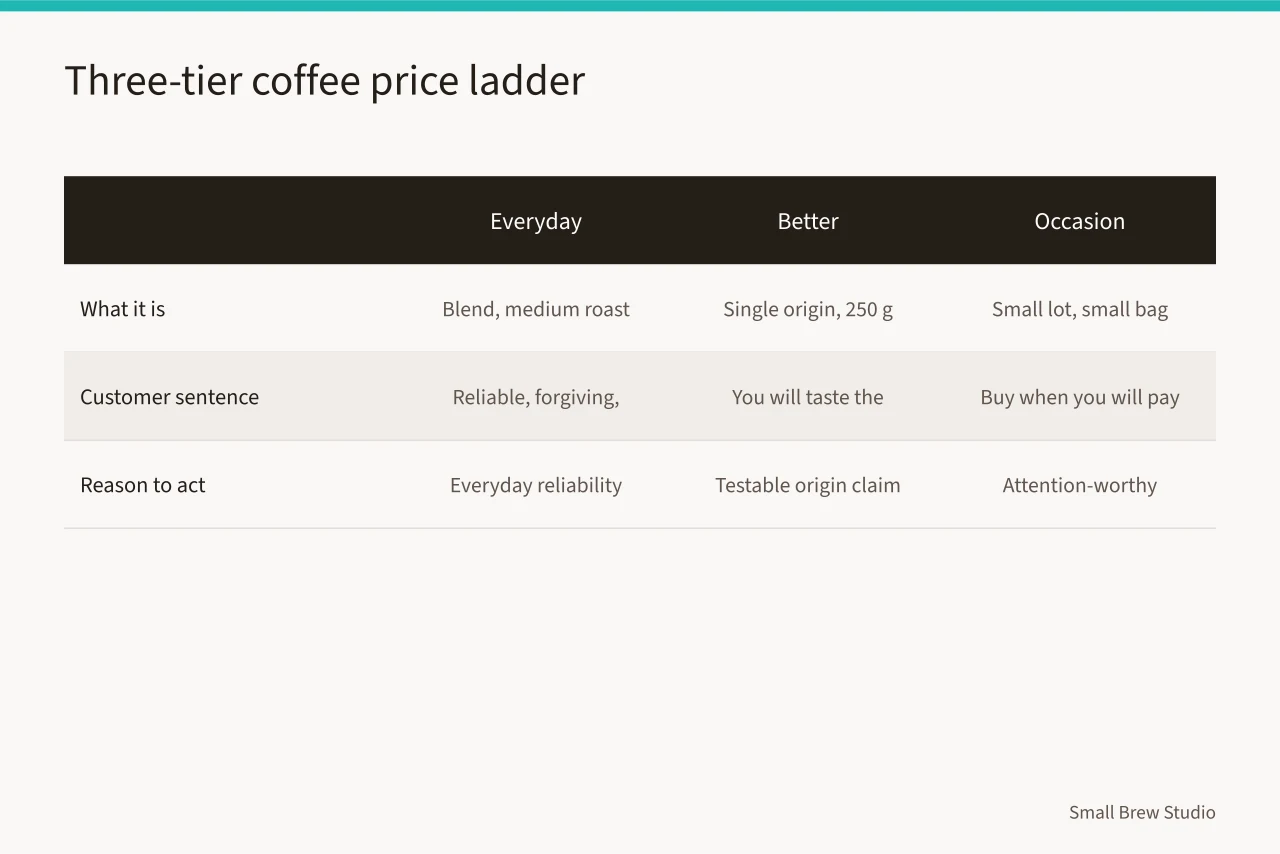
What it is
- Everyday
- Blend, medium roast, larger bag
- Better
- Single origin, roast date, 250 g
- Occasion
- Small lot, higher price, small bag
The sentence for the customer
- Everyday
- Reliable, forgiving, good with milk
- Better
- You will taste the origin
- Occasion
- Buy this when you will pay attention
Each tier needs a reason a customer can act on. "Premium" is not a reason. "You will taste the origin" is testable, which means the customer can find out whether you were right, which is how trust is built. A claim the customer can check beats an adjective, and checking one takes two cups and a spoon.
The gap has to be perceivable
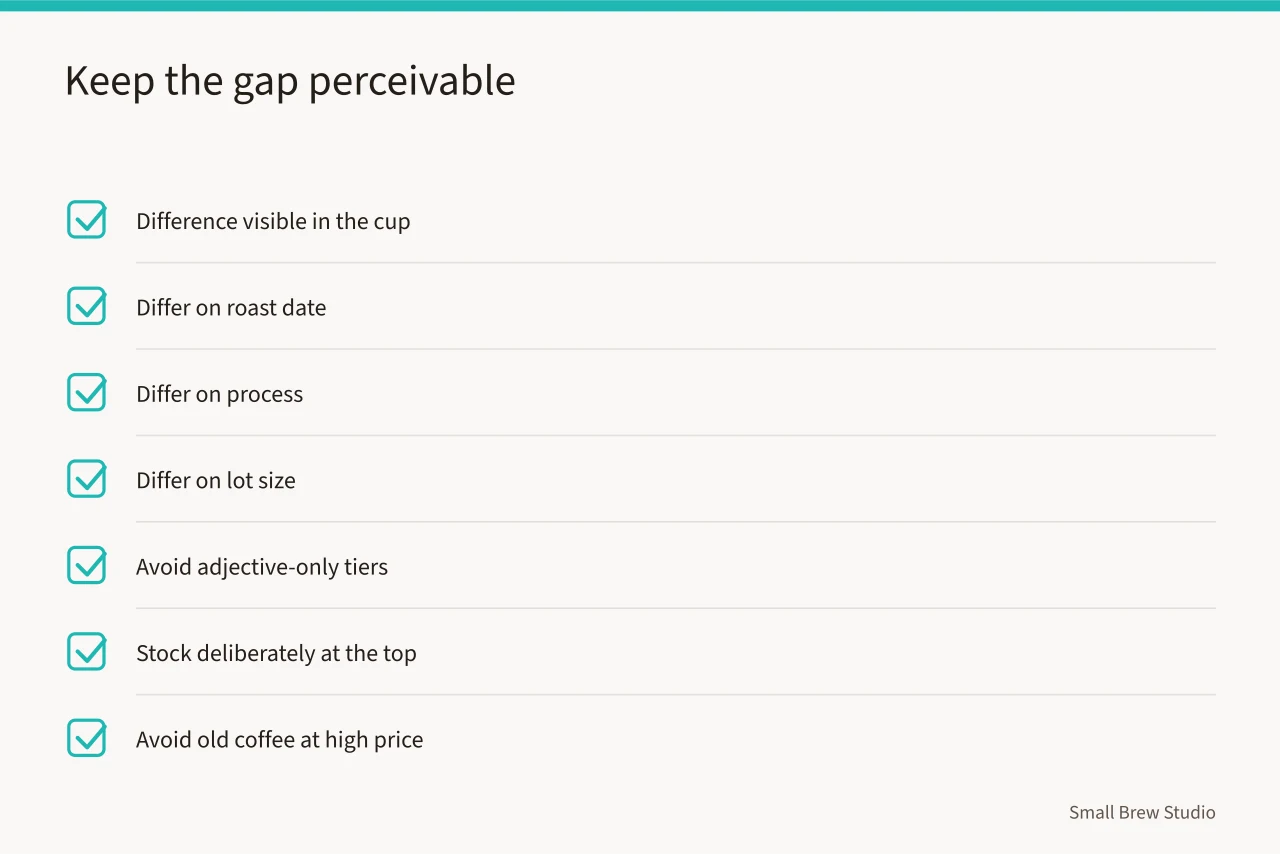
If the difference between two tiers is invisible in the cup, one of them should not exist. This is the discipline that keeps a ladder honest. It also means the tiers should differ on something specific, roast date, process, lot size, rather than on adjectives.
Testing a gap is simple and worth doing before you give it shelf space. Brew the two tiers side by side with the same dose, the same grind and the same water, serve them in unmarked cups, and ask staff to say which is which. If the difference is not there blind, it is not there on the shelf.
A shop can use three months without a sale as a review trigger for an occasion tier. Check whether the stock still supports the tier's promise, or whether it is time to reorder, replace, or remove it.
Review supply and availability
A review of coffee leaf rust in Latin America and the Caribbean provides context for supply uncertainty. Keep the shelf plan focused on choices the shop controls: clear tier differences and a fallback if an origin is unavailable.
An origin's availability can change. Keep the customer promise tied to the cup profile, not solely to a named source that may need to change.
When green prices rise, revisit the shelf price rather than letting an unexamined cost change accumulate. Explain the change plainly to customers, and keep the tier promise anchored in what they can taste.
Convenience is a separate business
Single-serve and grab-and-go formats serve a different buying need than whole-bean bags. Treat them as a separate assortment decision, as discussed in this guide to coffee shop products and packages.
A convenience format belongs in the shop’s assortment when it serves a distinct buying need; it should not fill a tier in the whole-bean ladder.
Density, speed and price drive that category. If you stock it alongside whole bean, keep the two visually separate, because a customer shopping for convenience and a customer shopping for flavor are answering different questions.
The stocking checklist
- Three tiers, each with a written one-sentence difference.
- Roast date on every bag, everywhere on the ladder.
- One bag size per tier, so the price comparison is legible.
- A stated policy for what happens when green prices move.
- Convenience formats shelved apart from whole bean.
That point matters. A shop that mixes the two teaches nobody, and a customer who could have moved up a tier never sees the ladder.
The ladder is also where to be candid about what more money actually changes. The customers who ask the sharpest questions usually have started testing purchases against each other at home.