Guides
What actually decides which coffee station a shop or bar chooses?
The constraints that actually shape a commercial coffee station: regulation, water, throughput and cleaning, and which of them carry over to a home setup.
This is not a report on how one shop made its pick. It is the constraint set every commercial coffee station is built against, and those constraints arrive in a fixed order: regulation, peak throughput, water and cleaning. The coffee stations businesses install are decided by those four, rarely by taste, and most of them stop applying at home.
What to take away
- Regulation shapes commercial stations far more than taste does, and it starts before construction.
- Throughput sets the equipment, not the other way round.
- Water is a running cost and a maintenance problem, not just an ingredient.
- Most commercial constraints do not transfer home, and copying them wastes money.
Regulation comes first
Before anyone picks a grinder, the premises have to satisfy the local health department, which enforces the FDA Food Code as the state has adopted it. Preparing ready-to-eat food or drink on site means submitting construction plans for plan review and holding a foodservice permit before you open. Coved corners, dedicated sinks and specified surfaces come out of that review, not out of the coffee.
Packaged goods sold from the same counter usually fall under a different agency: the state department of agriculture, which inspects retail food, while the FDA sets labeling rules and the USDA covers meat and poultry.
The exact division varies by state, and that is the point: the answer for a shop is jurisdictional rather than technical, and it explains why commercial counters look the way they do. A coffee bar inside a licensed bar picks up a second regulator — the state alcohol control board — because that license covers the counter the espresso machine sits on.
Throughput decides the equipment
The single number driving a commercial setup is drinks per hour at peak, not per day. A counter serving forty drinks in the eight o'clock hour needs grinders that recover instantly, a boiler that does not sag, and space for two people to work without colliding.
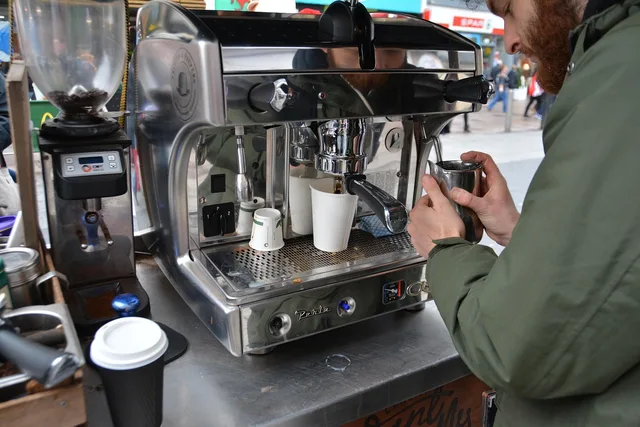
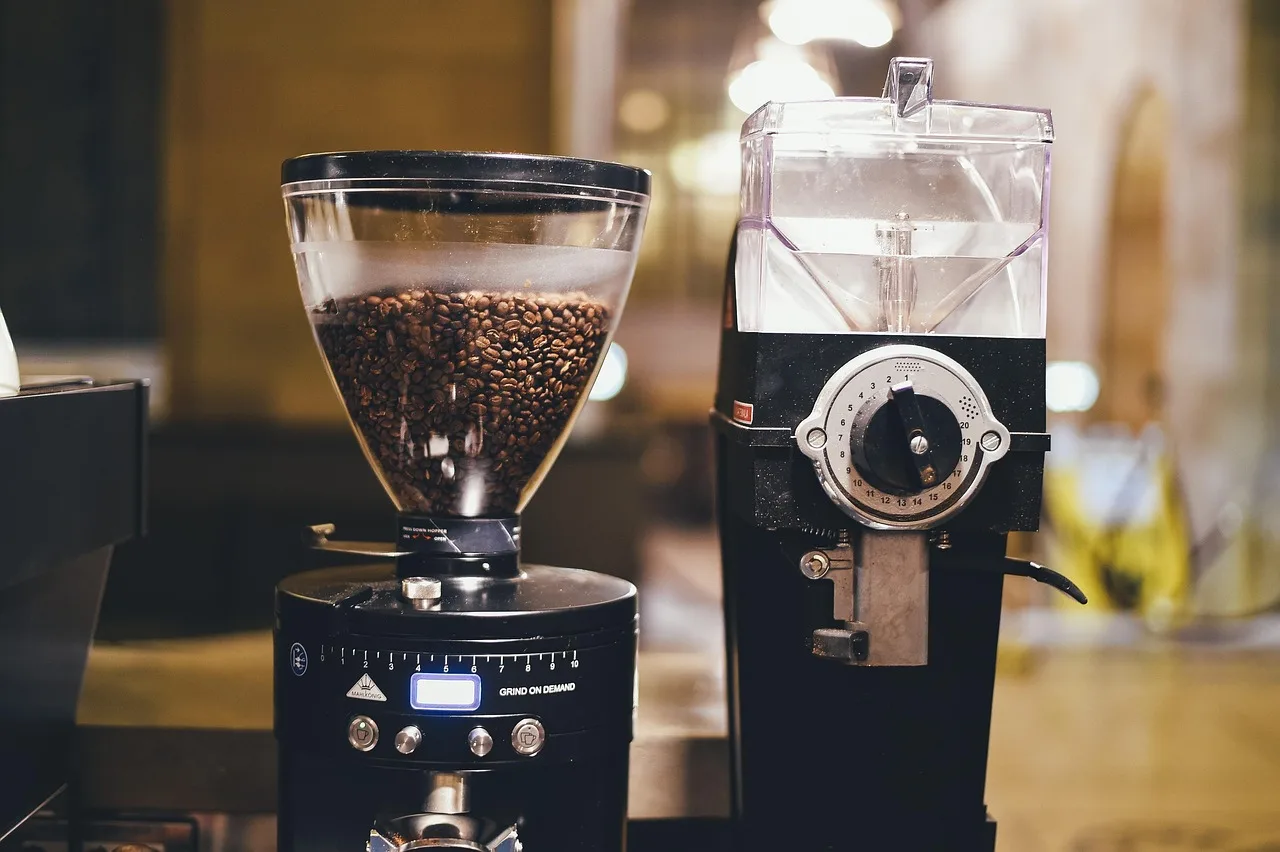
Equipment follows from that number. A counter built for a peak hour runs a plumbed heat-exchanger or dual-boiler machine, usually multi-group and in the La Marzocco class, with flat-burr grinders such as the Mazzer Super Jolly for espresso and a Mahlkönig EK43 for filter and decaf. A low-volume bar can cover the same menu with a single group and one grinder.
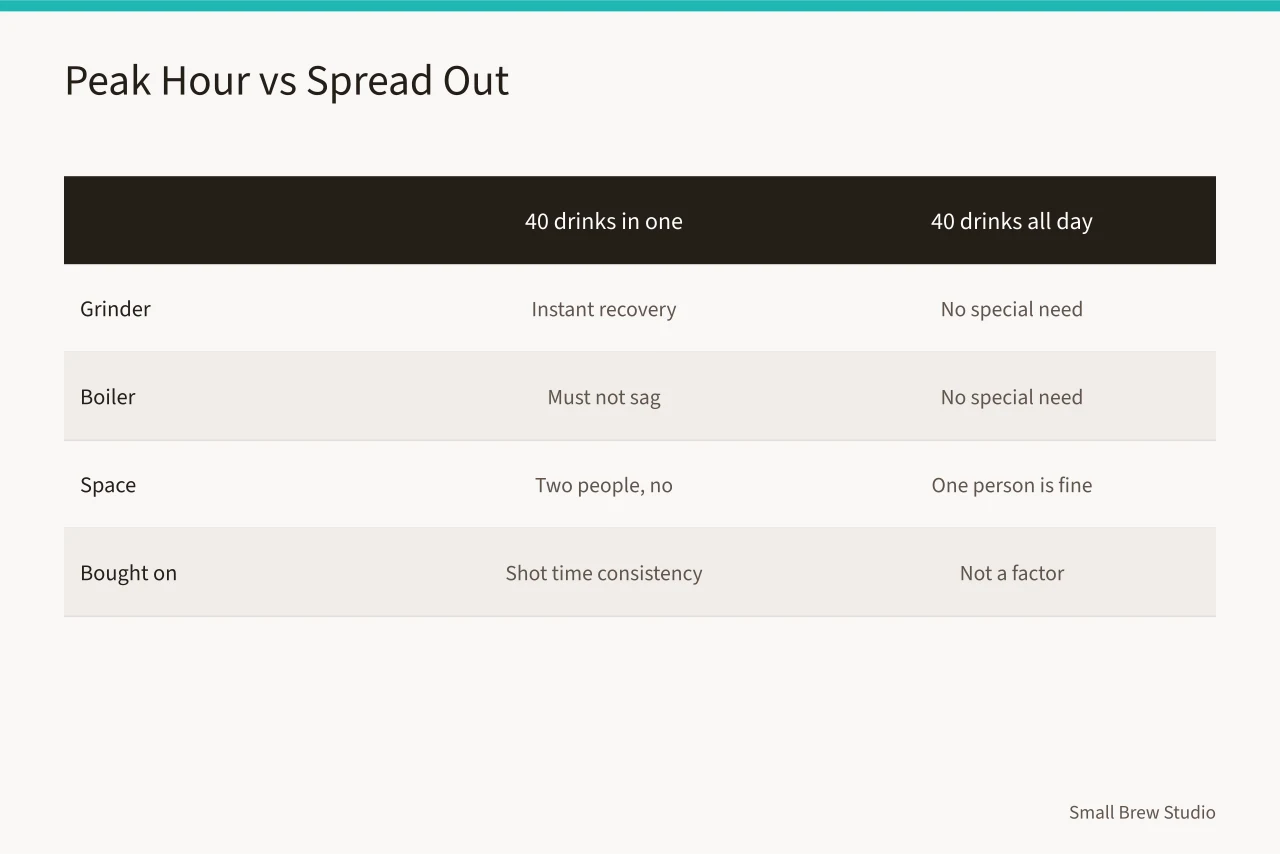
A counter serving forty drinks spread across the day needs none of that. The grinder side of that is shot time consistency held through a shift, which is the metric the machine is actually bought on.
This is why commercial recommendations mislead at home. A machine specified for recovery under sustained load is solving a problem you do not have, and it is usually solving it by being large and hot.
Water is a running cost
Water arrives twice on the bill: what it costs to buy, and what it costs when it damages equipment. A commercial account is metered, and usage is billed in gallons or in hundred cubic feet (CCF), units few operators can convert in their head.
A leak shows up on that meter before it shows up anywhere else, which makes the water bill a maintenance alarm as much as a cost record.
The maintenance side is scale. Hard water deposits mineral scale on heating elements, which slows heating, then breaks the machine. Commercial sites treat water with carbon block filtration and a softener — Everpure and BWT are the names you will see specified — because a failed boiler closes the business for a day.
Cleaning is scheduled, not remembered
The other structural difference is that a commercial station cleans on a schedule with a written procedure and someone accountable for it. Group heads backflushed daily, grinder burrs cleaned weekly, and a closing routine that is the same whoever is on shift.
At home the equivalent is much simpler, but the principle is the one worth stealing: a fixed short routine beats a thorough one you skip. On a grinder that routine runs to about five minutes once a week, which is the whole of what a home machine needs.
What carries over to a home station
| Commercial constraint | Carries home? |
|---|---|
| Health department construction rules | No |
| Peak throughput sizing | No |
| Water treatment for scale | Yes, if your water is hard |
| Scheduled cleaning routine | Yes |
| Everything in reach of one position | Yes |
Two things transfer, both habits, not purchases: treat your water if it scales your kettle, and clean on a fixed rhythm.
The commercial playbook solves problems created by volume, so plan a home station around your own sequence instead. Equipment questions get simpler once you accept that, and the criteria to judge by are the domestic ones.