Guides
What a cafe should get in writing from an independent coffee roaster
A cafe picks an independent coffee roaster on reliability first. The terms to get in writing: delivery, support, equipment, price notice and origin paperwork.
When a cafe or bar picks an independent coffee roaster, it is choosing a wholesale supplier, and the choice runs on supply terms: reliability, lead time and shipping cost, traceability paperwork, training and support, equipment loans, price stability, delivery rhythm and bag size. Most of them are invisible from the customer side of the counter. Lead times, minimum orders, bag sizes and notice periods differ from one roaster to the next, so there is no standard figure to hold a quote against. The figure that counts is the one the roaster puts in writing, and each section below lists what to ask for.
What to take away
- Supply reliability outranks flavor in a wholesale relationship, because a cafe cannot run out.
- Lead time and shipping cost are the levers a coffee supply chain is optimized on.
- Traceability paperwork is becoming a real requirement, not a marketing choice.
- Get every term in writing before the first order, not after the first missed delivery.
Reliability is the first filter
A cafe serving several hundred drinks a day cannot substitute a coffee at short notice without changing every recipe on the bar. That makes consistency of supply the first requirement, ahead of the cup score.
The pressures behind that are structural. A 2025 PLOS One study by industrial engineers at Yarmouk University and Jordan University of Science and Technology, "Improving the performance of the coffee supply chain using integrating fuzzy MCDM and simulation methods", analyzed a national coffee supply chain with fuzzy multi-criteria decision methods and simulation.
It framed the improvement problem explicitly as reducing lead time and shipping cost, amid pandemic disruption, adverse weather in producing regions, price dynamics and rising transport costs.
Those are the terms a wholesale relationship is negotiated in. A roaster who is excellent but unpredictable loses to one who is good and never late. The whole counter is specified that way, since throughput at peak sets the equipment rather than taste doing it. In writing, ask for the order cut-off, the usual days from order to delivery, who pays shipping, and what the roaster does when green coffee for a blend runs short.
Traceability is becoming paperwork
Origin claims used to be marketing. They are increasingly documentation.
A 2023 study in Food Science & Nutrition on the origin traceability of Ethiopian Arabica coffees says the country still needs to benefit from its single-origin product, due to a lack of appropriate traceability information to register for its geographical indication. Registering a geographical indication, the authors write, requires demonstrating the link between a product's quality and the region where it is produced, through traceability mechanisms.
In the US, one word on a coffee label already carries a legal paperwork requirement. Under the USDA organic certification rule at 7 CFR 205.100, each operation that produces or handles products sold, labeled or represented as "organic" must be certified, apart from listed exempt operations. A cafe that puts "organic" on its board can ask the roaster for its organic certificate before relying on the claim.
For a shop, that shift means a roaster who can produce documentation is easier to work with, and a roaster who cannot may become a liability as requirements tighten. Ask for the origin and certificate papers with the first price list, for every coffee the menu names by origin.
Ask which mark the roaster actually holds, because a word on the bag is a document somewhere else. In North America that mark is the Fair Trade Certified Mark, the equivalent of the International Fairtrade Certification Mark used in Europe, Africa, Asia and Australia; another roaster will carry the Rainforest Alliance Certified seal, and a third will run its own direct trade standard instead of a third-party mark. For a coffee named by region the trail runs back to the origin, and Ethiopia keeps its register of geographical indications at the Ethiopian Intellectual Property Office, so the certificate of origin and the traceability record behind each single-origin name belong with the first price list. Roasters who also sell into the European Union carry plot-level geolocation data for the EU Deforestation Regulation, and the same file should come with the coffee.
The other constraints
- Training and support.A roaster who will dial in a new machine and retrain staff after turnover is worth paying a premium for, because staff turnover in cafes is high. Ask whether support visits are included or charged, who comes when a new hire starts, and whether the roaster will reset the grinder when it changes a blend.
- Equipment loans.Common in wholesale, and they tie a shop to a supplier in ways that are worth knowing about before judging a shop's choice. Ask who owns the machine and grinder, whether the loan depends on a minimum purchase, who pays for servicing and repairs, and what happens to the equipment if the shop changes roaster.
- Price stability.A shop needs notice of increases, because menu prices cannot move weekly and every change costs goodwill. Ask for the notice period in writing, the date the current price is fixed until, and whether increases follow the green coffee market or the roaster's own costs.
- Delivery rhythm.Weekly beats fortnightly for freshness and for cash flow, and it lets a shop hold less stock in a small back room. Ask for the order cut-off, the delivery day, any minimum order, and what the roaster does when a delivery is missed.
- Bag size.Wholesale bags are large, which is fine at volume and terrible for a quiet week. Ask which sizes are offered, whether a smaller bag is available for slow weeks or a guest coffee, and whether every bag carries a roast date.
A roaster who answers all five in writing, before the first order, has already shown the reliability the first filter asks for.
The term sheet to hand the roaster
These clauses are the blanks, not the answers. Lead times, minimum orders, bag sizes and notice periods differ roaster by roaster, so the roaster completes the sheet and the returned copy becomes the benchmark every other quote is held against. Equipment loans usually stay the roaster's property while a purchase commitment runs, which is why the buy-out figure and the service interval belong in the same document as the coffee terms. Print it, send it with the first inquiry, and keep the returned copy as the record.
- Delivery.Orders placed by [cut-off time] ship on [delivery day] and arrive within [number] days; shipping is paid by [party]; a missed delivery is made good within [number] days.
- Order size.Minimum order is [weight] per delivery; coffee is supplied in [bag sizes], and every bag carries a roast date.
- Price.Prices hold until [date] and for every order placed before it; an increase takes effect no sooner than [number] days after written notice and never applies to orders already accepted.
- Origin papers.Origin documents, the organic certificate, and any third-party mark the roaster claims come with each price list, for every coffee the menu names by origin.
- Equipment.The [machine and grinder] remain the roaster's property; servicing is included every [number] months; the buy-out price is [amount] after [term].
- Training and support.[Number] hours of new-hire training and a dial-in visit after every blend change, included in the wholesale price rather than invoiced separately.
- Term and exit.Either side may end the agreement on [number] days' written notice, with equipment and open orders settled as follows: [terms].
What this means for you
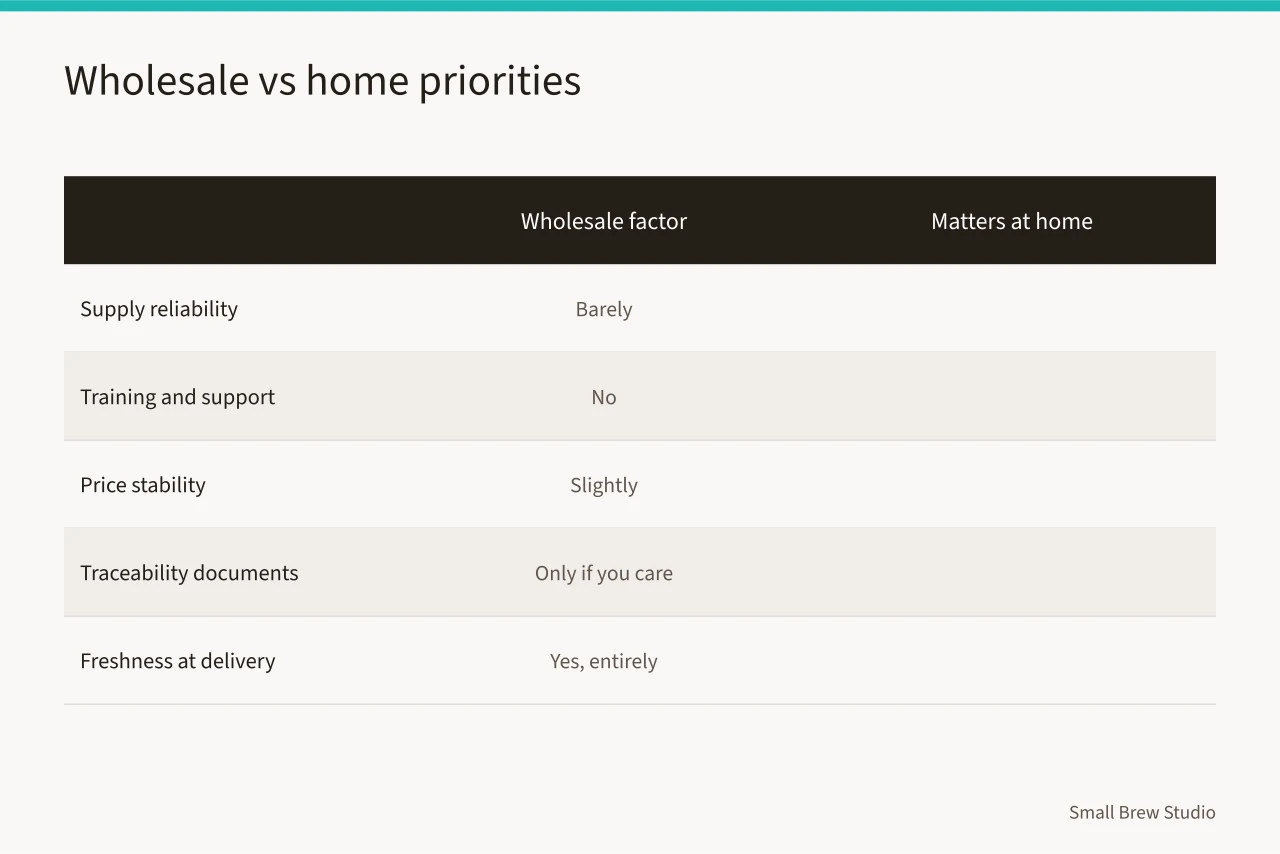
| Wholesale factor | Matters at home |
|---|---|
| Supply reliability | Barely |
| Training and support | No |
| Price stability | Slightly |
| Traceability documents | Only if you care about the claim |
| Freshness at delivery | Yes, entirely |
The table above is the reason a cafe cannot buy like a household, and it is also why the written terms weigh more on the cafe side of it. A home buyer can switch roasters every month with no consequence; a cafe that switches retrains the bar, re-specifies every recipe and reprints the board. The one concern both share is freshness on arrival, which is checkable on the bag and belongs in the cafe's written terms as a roast date on every bag.
When a cafe's coffee tastes better than the same beans brewed at home, the reason is usually turnover and routine — the things a wholesale agreement is meant to guarantee: a roast date on every bag, a delivery day that keeps stock moving, and support that resets the grinder after each blend change. That is why those terms are worth more in writing than in conversation.